
Showing all posts about language
Move over Oxford commas, em dashes a tell tale sign of AI use
23 April 2025
Another punctuation mark I’ve been a long time user of — the em dash — is apparently synonymous with text created by AI chat bots. Marvellous. You can see two instances of em dashes in the first sentence of this post. Last October I learned the presence of Oxford commas hinted at the use of AI to generate written work. If that is indeed the case, at least AI, by choosing to use the venerable punctuation mark, is showing its intelligence.
Even if that, as an Oxford comma fanboi, makes me look bad.
But back to em dashes — which you’ve probably noticed I apply incorrectly here, by placing a space between it and a word, instead of joining them up like this—the observation em dashes were indicative of AI’s presence, was made by LinkedIn influencers. LinkedIn influencers? Are they even a thing? According to these influencers however, the presence of em dashes can only mean text they feature in was generated by an AI technology.
Real people, it seems, use hyphens instead. How bizarre. Hyphens, of course, serve a completely different purpose. They are used to join words together. Em dashes are used to add a different, but possibly related, idea to a sentence. Why on Earth then use a hyphen in place of an em dash? But the LinkedIn influencers may be onto something. On most keyboards, the hyphen shares a key with the underscore symbol. In my experience though, there is no dedicated em dash button.
On my writing app, called Writer, I need to type in two colons, with three (oh, the irony) hyphens — or minus signs — in the middle, like this: :- – -: to render an em dash. Other word processors might allow this by, say, pressing the ALT key and entering a sequence of numbers, or trying the Insert, Special Character command, in the app’s menu bar. The point here though is hyphens are a little easier for a person to add, than are em dashes.
Therefore, the only possible conclusion that can be reached, by LinkedIn influencers I grant you, is that em dashes could only be the work of an AI app, never a lazy human. Certainly not one who won’t tap out a few extra key strokes, or copy and paste an em dash that may be elsewhere on the same document. But I doubt any of these thoughts crossed the minds of the LinkedIn influencers.
They were probably trying to chase down their next this-idea-might-go-viral post. If only creating viral content were as simple as selecting some random punctuation mark, and making up some absurd claim about it.
RELATED CONTENT
artificial intelligence, language, trends
Book publisher Simon & Schuster says no to celebrity blurbs
17 February 2025
Lucy Knight, writing for The Guardian:
[] soon we may not see so many of these author blurbs — Sean Manning, publisher of Simon & Schuster’s flagship imprint in the US, has written an essay for Publishers Weekly explaining that as of this year he will “no longer require authors to obtain blurbs for their books”.
A celebrity blurb is where a well known author offers some brief praise for the work of a new, or not so well known, writer. Examples could be something like: “a veritable page-turner”, or “a forceful new talent”. But it’s not always clear whether the author offering the endorsement has even read the book in question. That’s one reason why I take a dim view of celebrity blurbs.
I’m more interested in a novel’s synopsis, and then — where possible — seeking out some consensus as to whether the book is good or bad, through a website like Hardcover. After all, life is too short to spend reading novels you might not like.
But what surprises, and irks me, is that blurb is an official book publishing term. It sounds like a colloquialism, which it very much is, but it seems like a word people use because they don’t know the correct term to use. Sarney is a colloquialism, but sandwich is what is meant.
Wikipedia defines a blurb as a “a short promotional piece“, and celebrity endorsements aside, are usually more a short, yet enticing, summary of a novel. Here is the publisher’s blurb for Christian White’s most recent novel, The Ledge, which I wrote about last week:
When human remains are discovered in a forest, police are baffled, the locals are shocked and one group of old friends starts to panic. Their long-held secret is about to be uncovered. It all began in 1999 when sixteen-year-old Aaron ran away from home, drawing his friends into an unforeseeable chain of events that no one escaped from unscathed. In The Ledge, past and present run breathlessly parallel, leading to a climax that will change everything you thought you knew. This is a mind-bending new novel from the master of the unexpected.
That’s more like a synopsis, or even a summary, albeit with a promotional bent. Films are marketed with a similar sort of write-up, but synopsis is usually the go-to term, even though people sometimes call them blurbs. But blurb sounds like the sort of word I might otherwise be, maybe with some trepidation, looking up on Urban Dictionary.
Henceforth, I shall do away with the blubbery blurb, and go with synopsis or summary.
RELATED CONTENT
books, language, novels, publishing
Swearing may be a sign of intelligence, creativity… thank f**k for that
11 February 2025
The next time someone takes exception to your “bad language”, point them to this research:
Swearing may also be a sign of intelligence, is associated with less lying and deception at the individual level and higher integrity at the society level, and may be a sign of creativity. The offensiveness and the positive or negative consequences of swearing is highly dependent on the context.
RELATED CONTENT
The 2025 Banished Words List has recently dropped
16 January 2025
Lake Superior State University’s annual list of words and phrases we should cease using, was published recently. Among inclusions are game changer, era (you know why…), IYKYK (If You Know, You Know), and sorry, not sorry, which I can’t stand. Another term is dropped, but I don’t really take any notice off it, though maybe I should.
Once edgy and cool, “dropped” has become more of a letdown. Whether it is an album, a trend, or a product, this term has fallen flat. “Books, music, and all kinds of unnecessary things are currently being ‘dropped’ rather than introduced, released, or offered for sale. Banished for overuse, misuse, abuse, and hurting my head when all that “dropping” stuff lands on me!,” laments Susan of Littleton, CO.
Swedish House Mafia have dropped a new album. I’ve dropped a new blog post. But the image that usually forms in my mind is the item in question has ended up on the floor, rather than landing in a bookshop shelf, or a play-list, or whatever.
Also, reach-out is absent from the list. Or did the term feature in a previous year? Please feel free to contact, or message me, if you know.
RELATED CONTENT
2024 word the year: enshitiffication. I nominate IndieWeb for 2025
2 December 2024
The neologism, devised by blogger and author Cory Doctorow, just over two years ago, has been named the 2024 word of the year by Australian English wordbook, Macquarie Dictionary.
This must be some sort of record, between the time a new word is coined, comes into popular usage, and then named as a dictionary’s word of the year. Enshitiffication was among sixteen other candidate new words (PDF) shortlisted by Macquarie, and also won as the People’s Choice word.
It seems apt enshitiffication is selected as word of the year, given the rise in prominence IndieWeb/SmallWeb has experienced during 2024. If there’s any sort of counterpoint to the declining integrity of many of the social media platforms, IndieWeb/SmallWeb is it.
Macquarie accepts suggestions for their word of the year, and this might be an opportunity to bring the community/movement/concept/notion, however you like to describe IndieWeb/SmallWeb, to the notice of more people.
RELATED CONTENT
Oxford comma users: people may think AI does your writing
9 October 2024
Frequent use of the Oxford comma, also referred to as the serial comma, is — apparently — a tell-tale sign a written work was composed using an AI chatbot. The repeat use of the punctuation mark is among seven indicators researchers at Cambridge University, in the United Kingdom, identified after studying AI generated articles and essays.
As a life-long adherent of the Oxford comma — read enough of the content here, and you’ll notice them — this alarms me. AI doesn’t write a word here, every Oxford comma instance you see in my copy, was placed by me. On the up side, at least ChatGPT has the good taste to use the Oxford comma in the first place.
RELATED CONTENT
artificial intelligence, language, trends
Corporate jargon alternatives by Matt Watson
13 August 2024
American web developer Matt Watson has re-written many latter-day, jarring, corporate-speak terms, with words and phrases from long past times. For instance, instead of “circle back”, say “bring word again”. Or, replace “open communication” with the surely eye-brow raising “regular intercourse”.
In other examples, ASAP becomes “betimes”, change agent (what?) becomes “efficient cause”, while lean in is now “assiduously apply”. There are many more. Now all we need is a substitute to reach out. Hmm. Let me think. Hang on, I think I have it. How about “contact”?
RELATED CONTENT
Angel Baby, a story of doomed loved, and changing Australian accents
14 May 2024
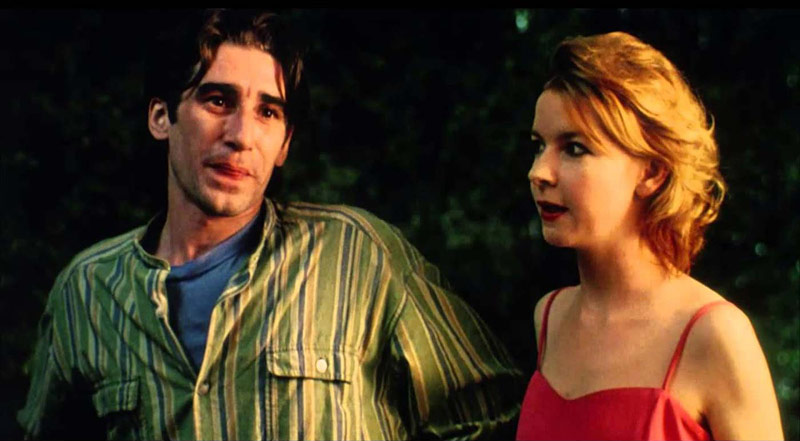
A scene from Angel Baby, a film by Michael Rymer, depicting stars Jacqueline McKenzie and John Lynch.
Angel Baby, trailer, is the 1995 debut feature of Australian filmmaker Michael Rymer. You may have seen some of his other work: Battlestar Galactica, Hannibal, both TV series, and/or his 2012 feature, Face to Face, but likely you’ve not have heard of Angel Baby.
Filmed in Melbourne, Angel Baby tells the story of a doomed love shared by Kate (Jacqueline McKenzie) and Harry (John Lynch), both of whom are battling severe mental illnesses. I won’t say too much more about it, except to note this is an example of under-appreciated Australian cinema.
And, possibly, an exemplification of how Australian accents have changed over thirty years. I say this because I was amazed at how distinct, how strong, some of the actor’s accents were. I live in Australia, and am surrounded by people with Australian accents.
That’s obviously a no-brainer — well, to an extent — but it means generally Australian accents should sound “neutral” to me, because I’m exposed to them daily. Mostly, that is. I spend several days a week in Sydney, a diverse city. Here, Australian accents are only a sample of the many I hear daily.
Perhaps this accounts for why I found some of the accents in Angel Baby so pronounced, so unmissable, because in reality I am not wholly immersed by them. But it seems to me, to detect an accent, local to the region you reside in, which may otherwise seem indiscernible, you need to go outside that area, to begin to perceive it.
I spent several years in London, England not Canada, and after a few months could easily detect Antipodean accents. It was an odd sensation to speak on the phone to lifelong friends living down under, and notice their accents. To notice, effectively, my accent. I wonder if you can pick up my accent on the phone, to lift a line from the Waifs’ 2002 song, London Still.
Australian accents are said to fall into three main categories: broad, general, and cultivated. The Australian accents I detected in Angel Baby had to be in the board category. Of course, there are any number of explanations as to why the accents seemed pronounced.
Could it be I was hearing not wholly familiar Melbourne variations of the Australian accent? Or could it be some of the actors were asked to emphasise their accents, Angel Baby being an Australian production, and all. Perhaps Rymer wanted people, particularly overseas audiences, to make no mistake they were watching an Australian film.
But I also began wondering if the internet was playing some part in my hearing Australian accents on Australian soil? Angel Baby was made in 1995. The year after 1994, which Angela Watercutter, writing recently for Wired, described as the last year before culture began to migrate online.
Could it be imagined Australian accents were among this migration, where they began to blend with every other English language accent, every other accent full stop, and begin altering? Of course, accents from other global regions are still distinct. I have no trouble discerning, for example, Irish, North American, or English accents.
Or those of other cultures, because different accents stand out. But might thirty years of internet culture, monoculture perhaps, be making a difference? Unlike thirty years ago, today we are constantly hearing, constantly absorbing, the voices of speakers from across the globe, on the web, and social media.
Might this be resulting in accents — I don’t know — dissolving into each other a bit? Are we unwitting students of elocution lessons, being served up through the world wide web? Accordingly, a “normal” Australian accent of thirty years ago, may sound quite different today. But who knows? Perhaps I am only imagining this would-be diction.
One thing is certain though. If you have the chance, look at Angel Baby. If you’re a Kanopy member, it may be available in your region.
RELATED CONTENT
film, Jacqueline McKenzie, John Lynch, language, Michael Rymer, trends
A not so deep dive into a not so new neologism
17 April 2024
When it comes to what’s published online, I consider myself a moderately well-read person. Obviously, I’m not across every last thing posted on the web, but I probably spend a good couple of hours a day following news sites, what’s on the RSS feeds I subscribe to, social media, and so on.
Despite this, what I’d describe as big news stories still seem to slip me by. I’m sometimes surprised to read, for example, that a major international sports fixture is about commence. Or a music act that is otherwise a household name, is preparing to play their first show locally, and I had no idea they were even in the country.
Maybe that’s why — prior to a few days ago — I’d seemingly missed seeing the term deep dive, which is being used to refer to in-depth news stories, and blog posts, on a given topic. It’s quite possible however I missed seeing the neologism, in my daily futile attempts to sidestep that other overused noob of a term, reach out.
Of course neither deep dive, nor reach out are neologisms, new terms, as such. People I’m sure have been deep diving, or feel as if they have been, in the oceans and other bodies of water for eons. Similarly, people have been reaching out to grab an apple from the fruit bowl, or take a book off a shelf, for many long centuries.
But it is the connotation these terms are used in, that is new, or rather, somewhat new. So before writing a post heralding the advent of a freshly minted neologism, in this case deep dive, I decided to have a look around. This actually amounted to a pretty perfunctory look around, consisting of but a single search engine query.
That query led me to Merriam-Webster, a “leading provider of language information for more than 180 years”. Thanks to their listing of deep dive, I learned the term had been used to describe “an exhaustive investigation, study, or analysis of a question or topic”, since, wait for it, 1986.
1986. That’s like ten years before the internet as most of us know it, come along. Either I’ve been hanging out in all the wrong places online, all this time, or someone on TikTok has only recently made the term deep dive go viral. Obviously, my money is on the latter.
RELATED CONTENT
Pre-production expenses: cost accounting for sex and drugs
6 April 2024
In this case, pre-production expenses would appear to relate to the costs associated with procuring illicit drugs, and the services of sex workers.
The term came to light during proceedings in the Australian Federal Court last week, in the course of a defamation case between a former federal parliamentary staffer, and an Australian TV broadcaster.
With “pre-production expenses”, have we witnessed the coining of a new euphemism? One that means to ask someone else to reimburse the costs another person incurred while obtaining sex and drugs? I’m not sure it’s entirely new, however. It could be accounting departments have been using the phrase to classify certain expenses for some time.
Still, as a possibly somewhat new euphemism, pre-production expenses can take its place in the vernacular along with the likes of assorted other terms, including “friends with benefits”, “pre-loved”, “wardrobe malfunction”, “between jobs”, and of course, “cook the books”.
RELATED CONTENT