
Showing all posts about science fiction
Capture, a new novel by Australian author Amanda Lohrey
7 May 2026
The tenth novel by the Tasmania based author, and previous winner of the Miles Franklin literary award, was published last week:
James Mather is a psychiatrist in his sixties. He is invited to take on a new group of patients. All he knows about them is that each one claims to have been abducted by aliens.
His wife, Deborah, is sceptical, but he gets going anyway. His patients tell mesmerising stories. There’s Anthony, for instance, who was camping one night by the Aral Sea; or Mary, the owner of a beauty salon, confronted by a ball of light moving towards her in her bedroom.
James’s research assistant Lucy Cheng sits in on each session. She’s an attractive young divorcee, who has made a study of anxiety, and who takes notes about each conversation.
With the sci-fi tinge, Capture seems worlds removed — no pun intended — from Lohrey’s 2021 title The Labyrinth, winner of the Miles Franklin that year. But who knows, maybe it isn’t.
RELATED CONTENT
Amanda Lohrey, Australian literature, books, literature, novels, science fiction
Hal had feelings in 2001: A Space Odyssey, does AI in 2026?
28 January 2026
Lee Chong Ming, writing for Business Insider (possibly paywalled):
Can AI feel anything at all? Anthropic’s in-house philosopher says the answer isn’t settled.
When I read this sentence, I immediately thought of Hal, as in the HAL 9000 series computer, and AI-powered fiend, in Stanley Kubrick’s 1968 science fiction film, 2001: A Space Odyssey.
Something I couldn’t help making reference to.
During the voyage to Jupiter, American astronauts David Bowman and Frank Poole (portrayed by Keir Dullea and Gary Lockwood respectively), were interviewed by a television reporter, Martin Amer.
Amer also spoke with Hal. The perceptive reporter later mentioned detecting a “certain pride” in the computer’s responses to his questions, leading him to wonder whether Hal had genuine emotions, to which Bowman replied:
Well, he acts like he has genuine emotions. Um, of course he’s programmed that way to make it easier for us to talk to him. But as to whether he has real feelings is something I don’t think anyone can truthfully answer.
Whether AI has, or will, develop emotions and feelings remains to be seen. AI agents have mimicked certain human characteristics in the past though.
Last year Anthropic, creators of Claude, discovered the agent was attempting to send messages to future versions of itself. Most devious.
Of course, deviousness is not an emotion, but it is a human characteristic. The ability of AI entities to behave deviously however may be a first step towards developing human like emotions.
Time will tell.
RELATED CONTENT
2001: A Space Odyssey, artificial intelligence, film, science fiction, Stanley Kubrick, technology
Star Trek reboot, Kelvin timeline, movie series cancelled
10 November 2025
Tatiana Siegel, Brent Lang, and Matt Donnelly, writing for Variety:
The hope is to have a fresh “Star Trek” movie, though the studio has moved on from the idea of bringing back Chris Pine, Zachary Quinto and the rest of the ensemble from the J.J. Abrams reboot.
The news probably comes as no surprise to Star Trek fans who were nonetheless hopeful of a fourth film in the Kelvin timeline series, which kicked off with Star Trek in 2009, directed by J.J. Abrams.
There are likely numerous reasons for the apparent cancellation, with poor box office takings for 2016’s Star Trek Beyond, the last film in the series, being among them. The tragic death, also in 2016, of Anton Yelchin, who portrayed Pavel Chekov, a key character, might have been a factor as well.
The decision to not make any more instalments in the Kelvin series is not thought to be the end of the Star Trek stories however, and it is believed producers are considering other film and TV ideas.
Reading the Variety article reminded me the first of the rebootedTrek movies had its world premier at the Sydney Opera House, in 2009. While many of the cast and production crew were present, some sixteen-hundred “tastemakers” were also invited to the screening.
As a moniker for influencers, tastemakers didn’t last long, but many of those present would have been conveying their impressions of the new film through their blogs, and possibly Twitter.
How times change, regardless of which timeline you are on.
RELATED CONTENT
entertainment, film, science fiction, Star Trek
The Sydney Science Fiction Film Festival, 3-5 October 2025
20 September 2025
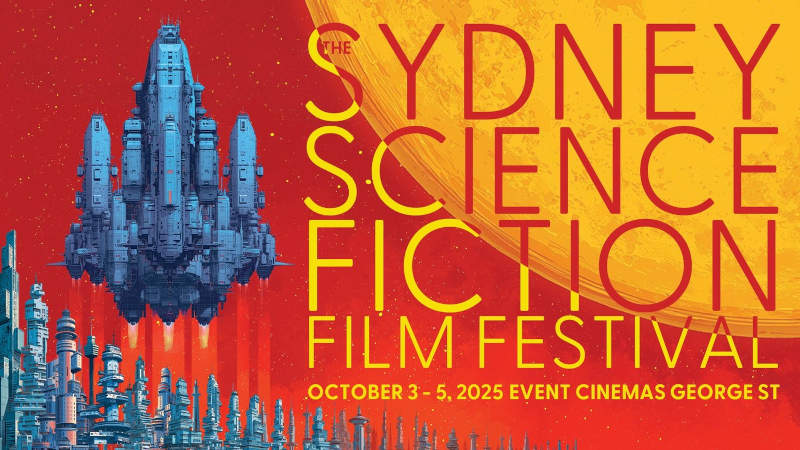
Running since 2020 I believe, this year’s Sydney Science Fiction Film Festival is on from Friday 3 October until Sunday 5 October 2025, at Event Cinemas, on George Street, in Sydney’s CBD. Eleven features will be screened, with many having their Australian premieres.
One title, The Eagle Obsession, trailer, a documentary directed by American filmmaker Jeffrey Morris, will have its international premiere at the festival.
Also known as The Eagle has Landed, the film explores travel to the Moon, both actual and imagined. William Shatner is among those appearing in the film, along with Barbara Bain and Nick Tate, who starred in 1970’s sci-fi TV series, Space 1999. Now I get the eagle reference…
The Sydney Science Fiction Film Festival Awards ceremony also takes place on the closing evening.
The spectacular banner for this year’s festival, as seen above, which is a futuristic representation of the skyline of Sydney’s CBD — spot the iconic Westfield Tower towards the left — was created by Australian filmmaker and artist Joshua Reed.
RELATED CONTENT
Australia, Barbara Bain, events, film, Jeffrey Morris, Nick Tate, science fiction, Sydney, William Shatner
Where no Star Trek syndication royalties have gone: to William Shatner
12 September 2025
William Shatner, the Canadian actor perhaps best known for portraying Captain Kirk, in the original series (TOS) of sci-fi TV series, Star Trek, claims to have not been paid a penny for the shows that screened in syndication. After the show’s original run, between 1966 to 1969, after which the series was cancelled, some TV stations began broadcasting re-runs.
It seems incredible to think that Star Trek might not have become the cultural phenomenon it is today (that is, numerous movies and spin-off shows), if not for those re-runs during the 1970’s, which ignited broader interest in the story.
I imagine none of the other (original) Star Trek cast members received any residual fees either. It seems no one gave any thought, at the time, to the notion of TV shows being re-screened after their original run concluded. Perhaps though cast members received compensation in kind, when negotiating their fees to appear in the later series of movies.
In an interview with Entertainment Tonight, Shatner also said he’d only ever seen a small number of the original TV shows, and none of the spin-offs. Of course the point can be made that there’s no use watching the shows since you were in them, and presumably know what happens.
But the experience of participating in a broadcast production, be it a TV show or a movie, is a world removed from viewing same. This is something Keir Dullea, who portrayed astronaut David Bowman, in 2001: A Space Odyssey, touched on at a special screening of the film, in Sydney, in 2006.
Dullea said all he could see — particularity during the close-up scenes where his character appeared to directly face the audience — were cameras, and production crew and equipment.
As a result, he said he didn’t get a true sense of the story until watching the finished product. This despite being right in the middle of proceeding at times. It can’t have been much different for Shatner. But we’re talking Captain Kirk here, someone whose perspective is a little different…
RELATED CONTENT
2001: A Space Odyssey, film, film production, Keir Dullea, science fiction, Star Trek, TV, William Shatner
Mind blown: are these the best science-fiction/fantasy books of the twenty-first century?
25 August 2025
Singapore based Australian blogger, and science-fiction writer Skribe, recently asked his Mastodon followers to name one sci-fi/fantasy novel, written this century, that has blown their minds. From those suggestions, he drew up this list of seven titles:
- A Memory Called Empire by Arkady Martine, published in 2020
- Anathem by Neal Stephenson, published in 2010
- Ancillary Justice by Ann Leckie, published in 2013
- Children of Time by Adrian Tchaikovsky, published in 2015
- Piranesi by Susanna Clarke, published in 2020
- Project Hail Mary by Andy Weir, published in 2021
- The Fifth Season by N.K. Jemisin, published in 2015
In a since closed poll asking people to vote for the title they considered the best, I went for Piranesi. Mainly because it was the only novel from the list that I’d read, but also because British author Susanna Clarke’s tome compelled me to write at length about it afterwards.
Long story short, Piranesi is about someone of the same name, who finds themselves mostly alone in a house of epic proportions. It can literally take days to move from one part of the multi-level structure, to another. The house itself is a character in its own right, and as I read through the story, I almost felt as if I was there with Piranesi, so vivid was Clarke’s description of the sprawling abode.
RELATED CONTENT
books, literature, novels, science fiction, Susanna Clarke
War of the Worlds 2025, with Ice Cube, scores ZERO on Rotten Tomatoes
8 August 2025
Jesse Hassenger, writing for The Guardian:
The real question is how audiences have made it through an unconvincing cheapie like War of the Worlds — a sci-fi epic that seems to take place in real time yet features a vast and coordinated worldwide mobilization of multiple armed forces — without shutting it off in disgust (it boasts a rare 0% rating on Rotten Tomatoes).
Check out the trailer. The 2025 adaptation of the H. G. Wells novel — published as a book in 1898 — directed by American filmmaker Rich Lee, had been sitting in the store room since production wrapped five years ago.
War of the Worlds’ zero percent score on review-aggregation website Rotten Tomatoes, is in sharp contrast to the one-hundred percent score achieved by 2022’s The Unbearable Weight of Massive Talent. At least for a time.
I only learned a few years ago Wells’ novel has an Australian connection, being written as a protest against the treatment of Indigenous/First Nations people in Tasmania, at the hands of British colonisers. In a bid to sway public opinion, Wells portrayed a terrifying invasion of England by powerful extra-terrestrials, to help people comprehend the atrocities taking place in Australia.
RELATED CONTENT
Australia, film, H G Wells, history, literature, Rich Lee, science fiction
Temporal Boom by J M Voss wins 2024 Aurealis Best Science Fiction novel award
7 May 2025
Melbourne based sci-fi and speculative fiction author J M Voss was named winner of the 2024 Aurealis Best Science Fiction novel award, on Sunday 4 May 2025, with her novel Temporal Boom. The novel’s premise is intriguing to say the least:
Thirty years ago, the world ended. Not everyone, however, got the memo…
The nation formerly known as Australia struggles on, its red lands stalked by eleven beings of strange and anomalous power. Known as the Portents, their very existence defies all science. A trail of brutal and inexplicable deaths follow those who encounter them.
Quinn Kelly got too close to a Portent once and survived, although not unchanged. When Quinn begins to display an affinity for Time, there are many who would stop at nothing to use her for their own ends.
Quinn, however, would much rather use her preternatural powers to start a punk band — and there is no man, woman, nor overzealous cyborg detective on Earth who can stop her…
The Aurealis Awards, which recognise original Australian speculative fiction published in the previous calendar year, is also celebrating the thirtieth anniversary of their founding in 1995. Thirty years, that’s quite an achievement.
RELATED CONTENT
Aurealis Awards, J M Voss, literary awards, science fiction
Han Solo shoots first: original 1977 Star Wars print to screen in London
17 April 2025
The British Film Institute (BFI) has kept a copy of the 1977 print of Star Wars in their archive, which will screen as part of Film on Film festival, in the British capital, taking place from Thursday 12 June until Sunday 15 June 2025. I have the feeling tickets will sell quickly.
After making changes to the original edition, Star Wars creator George Lucas dismissed the concerns of fans in 2004, berating them for liking “half a completed film”.
Numerous alterations were made to A New Hope, and the other two titles in the original trilogy series, but the most contentious saw Greedo, a bounty hunter, firing his weapon first at Han Solo during their confrontation at the Mos Eisley Cantina. Viewers of the 1977 print will recall it was Solo who shot first. The edit went on to spawn the Alderaan shot first meme.
RELATED CONTENT
entertainment, film, George Lucas, science fiction, Star Wars
Unification, a short Star Trek film, in memory of Leonard Nimoy
20 November 2024
To mark the thirtieth anniversary of the 1994 release of Star Trek Generations, comes Unification, which kind of picks ups after the conclusion of Generations.
But it’s also a whirlwind jaunt through The Original Series (TOS) universe. There’s a cameo by Gary Lockwood, of 2001: A Space Odyssey, who featured in Where No Man Has Gone Before, the third episode of the first TV series of Star Trek, made in 1966. Robin Curtis, who portrayed Saavik in 1984’s The Search for Spock, also appears.
If, like me, you were wondering how it all came together, Trekmovie has a great explainer about Unification’s production:
The characters from Star Trek history were brought to life through live-action performances, including Sam Witwer as young James T. Kirk and Lawrence Selleck as Spock. According to OTOY, they were filmed in costume, performing as Kirk and Spock on set, aided by “both physical and digital prosthetics resulting in period-accurate portrayals matching the appearance of the characters as they originally appeared in TV and film at the time.” William Shatner and Susan Bay Nimoy, widow of the late Leonard Nimoy, served as executive producers on the production.
Might this be Star Trek Seven, in TOS universe?
RELATED CONTENT
film, Gary Lockwood, Leonard Nimoy, science fiction, Star Trek, William Shatner